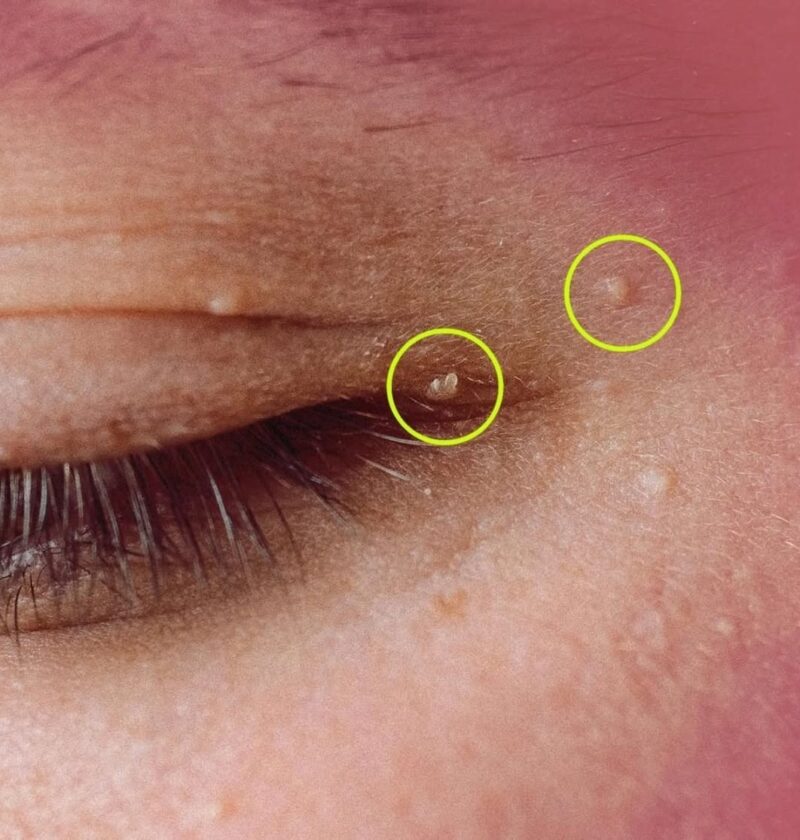
The headline is a bit misleading because milia are not actually “fat cysts.”
Milia are tiny white or yellowish bumps that form when keratin (a skin protein) becomes trapped under the skin. They’re common around the eyes, cheeks, nose, and forehead.
👀 What milia look like
- Small white or cream-colored bumps
- Usually 1–2 mm in size
- Firm to the touch
- Not painful or itchy
- Often mistaken for whiteheads or pimples
🧴 Can milia go away on their own?
Yes, some milia disappear naturally over time, especially in infants.
In adults, they may persist for months or longer.
✅ Ways to help prevent or reduce milia
Gentle exfoliation
Products containing ingredients such as:
- Salicylic acid
- Glycolic acid
- Lactic acid
may help prevent new milia from forming.
Retinoids
Some people benefit from topical retinoids, which increase skin cell turnover.
These should be used carefully and according to medical advice, especially around the eyes.
Avoid heavy creams if they’re contributing
Very occlusive skincare products can sometimes make milia more likely in susceptible individuals.
🚫 What not to do
Don’t squeeze them yourself
Unlike pimples, milia are not easy to pop.
Attempting to remove them can cause:
- Skin injury
- Infection
- Scarring
Be cautious with DIY remedies
Internet tips involving needles, scraping, toothpaste, lemon juice, or other home treatments can damage the skin.
🩺 Professional removal
If milia are bothersome, a dermatologist can often remove them safely using:
- Sterile extraction techniques
- Specialized instruments
- Other dermatologic procedures when appropriate
🚨 When to see a dermatologist
Consider evaluation if:
- The bumps are spreading
- You’re unsure they are milia
- They persist despite good skincare
- They appear after skin injury or treatment
🧠 Bottom line
Milia are tiny keratin-filled cysts, not fat deposits. They are harmless but can be annoying. The safest approach is gentle skincare and, if needed, professional removal rather than trying to squeeze or cut them at home.