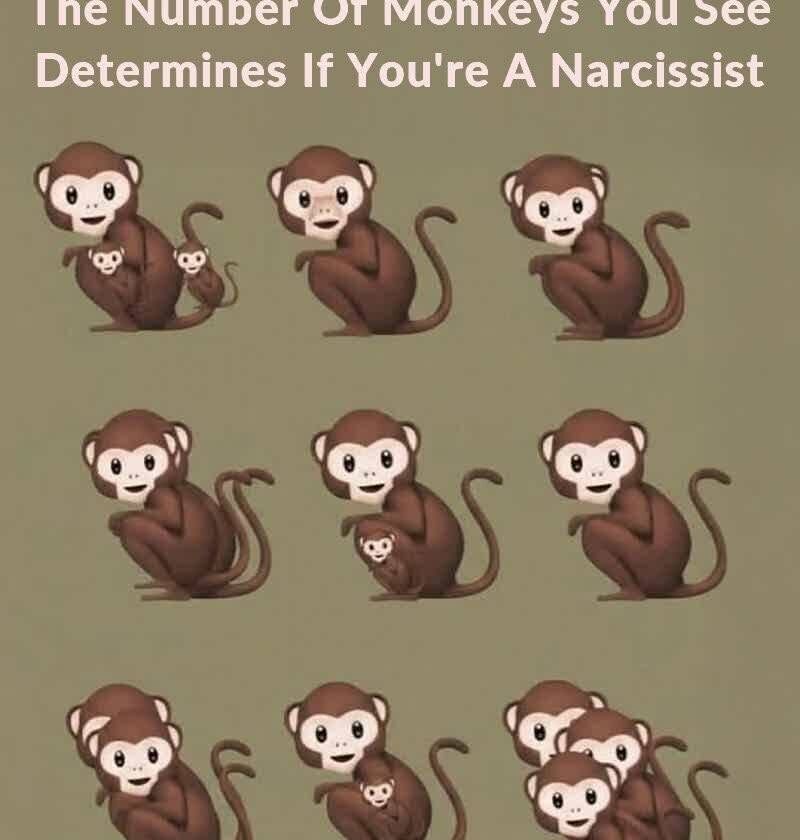
That “How many monkeys do you see?” type of image is usually less about monkeys—and more about how your brain filters information.
These puzzles are designed to test what psychologists call selective attention and perception bias.
🧠 1. Selective attention (your brain’s filter system)
Your brain is constantly bombarded with more visual data than it can process.
So it automatically:
- Focuses on the most “obvious” shapes first
- Ignores background or hidden elements
- Prioritizes patterns it recognizes quickly
That’s why different people can look at the same image and “see” different numbers.
👁️ 2. Figure vs. background perception
The brain separates what it thinks is:
- Figure = the main subject (what you’re supposed to notice)
- Background = everything else
In illusion images:
- Some monkeys are designed to stand out clearly
- Others are blended into patterns, shadows, or shapes
People often miss the hidden ones because their brain locks onto the most obvious “figure” first.
⚡ 3. Cognitive shortcuts (pattern recognition)
Your brain prefers speed over accuracy.
So it uses shortcuts like:
- “If it looks like a face/animal, count it”
- “Ignore messy or low-contrast areas”
- “Stop searching once a pattern feels complete”
This is efficient in real life—but it makes illusions tricky.
🧩 4. Expectation bias
If the question says:
“How many monkeys do you see?”
Your brain assumes:
- There is a clear, countable answer
- Everything relevant must be visible at the same level
But designers of these illusions exploit the fact that:
- Some monkeys are hidden in textures, outlines, or negative space
🔍 5. Attention is trainable
People who find more hidden objects tend to:
- Scan images more systematically (top to bottom, left to right)
- Slow down instead of guessing quickly
- Break the image into sections
It’s not “better eyesight”—it’s more deliberate attention.
🧠 Bottom line
These puzzles don’t measure intelligence. They measure:
how your brain filters, prioritizes, and interprets visual information under time pressure.
If you want, you can send me the exact “monkey” image you saw—I can break down why certain ones are easy to miss and where they’re hidden.